“It’s very hard to get things accomplished if you haven’t worked on structure and getting people on board before you proceed.” ---TJC stakeholder
In the beginning, developing shared goals, principles, and outcomes of interest will be the main work of the reentry implementation committee. Start by creating a timeline of what needs to be accomplished.
Review the TJC Implementation Roadmap for a to-do list to help get you started:
Drawing a stakeholder grid is an excellent exercise to identify local leaders, their relationship to the system, their interest, their power to affect system actions, and their alignment with the TJC model. In essence, you are teaching key stakeholders how to have this discussion at the system level while gauging interest or authority to implement or block change.
Your goal is to engage stakeholders through a variety of exercises and actions outlined in previous sections and then identify the level of power and interest each organization and agency has in transitioning people from jail to the community. This is a useful exercise to assist in systems-level discussions and to understand various influential leaders who exist within your system.
Below is an example of a stakeholder grid. We have listed different stakeholders below. Think where each one of them fits in your jurisdiction.
|
|
Stakeholder Power/Interest/Influence Grid
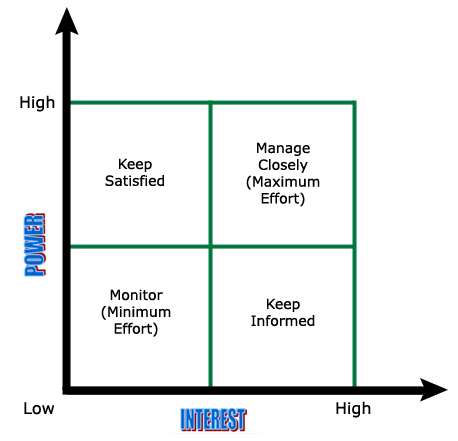
There are four squares in a stakeholder grid:
1. Keep Satisfied: Stakeholders who fall within this square are those who have a lot of power to influence criminal justice system practice or change, but have little interest in changing anything.
2. Manage Closely: Stakeholders who fall within this square are those who have a lot of power to influence criminal justice system practice or change and have a lot of interest in or desire to change current criminal justice practice to obtain improved outcomes.
3. Monitor: Stakeholders who fall within this square are those who have little to no power to influence criminal justice system practice or change and little to no interest in changing anything.
4. Keep Informed: Stakeholders who fall within this square are those who have little to no power to influence criminal justice system practice or change; but have a lot of interest in or desire to change current criminal justice practice to obtain improved outcomes.
By doing this exercise in a group setting, one is able to identify the organizations that have a high interest and power in the TJC model and learn what motivates them, while also identifying those organizations with low interest. It is extremely important to note that no stakeholder should be excluded from participating in TJC implementation activities because of their levels of interest or power.
The purpose of this exercise is to understand the different motivators for and against change within your system and to allocate resources and make determinations relative to communication and engagement strategies. Accordingly, dialogue should ensue about what it takes to engage people within the TJC effort, from empowering the low-interest and low-power organizations to understanding and managing differences that high-power stakeholders have with the TJC approach.
Drawing a Stakeholder Grid
First, ask your group to rate each of the stakeholders by their effect on transitioning people from jail to the community on a scale of 1 (least) to 10 for the following:
Based upon these ratings, plot each of the stakeholders on the Stakeholder Power/Interest/Influence Grid. Bryson (2003) lays out seven points of constructing a Stakeholder Grid:2
Whole team:
 |
6 of 11 |
 |
