California’s current budget
Governor Gavin Newsom released his
FY 2026 budget
proposal in January 2025. As of March 2025, he had not given the
state of the state address. The
FY
2026 budget was enacted in June 2025.
California enacted its
FY
2025 budget in June 2024. The budget reported $211.5 billion in
general fund spending, a decline of 5 percent over the previously
enacted budget.
Under the
American
Rescue Plan, California received $27 billion in direct state fiscal
aid and $14.7 billion in local government aid from the federal
government. As of
January
2025, California had fully allocated its state ARP. States must
spend the funds by Dec. 31, 2026.
According to the
National
Association of State Budget Officers (NASBO), California’s total
expenditures in fiscal year FY 2025 were $413.8 billion, including
general funds, other state funds, bonds, and federal funds. NASBO
reported that total expenditures across all states in FY 2025 were $2.9
trillion, ranging from $5.4 billion in Wyoming to $413.8 billion in
California.
According to NASBO,
California’s recent expenditure totals (general fund spending/total
spending, including federal transfers) were:
- FY 2025: $233.6 billion/$510.3 billion
- FY 2024: $205.7 billion/$452.7 billion
- FY 2023: $195.2 billion/$413.8 billion
- FY 2022: $216.8 billion/$442.2 billion
- FY 2021: $162.1 billion/$498.9 billion
- FY 2020: $146.3 billion/$357.1 billion
- FY 2019: $140.4 billion/$300.4 billion
For more on California’s budget, see
California’s budget institutions, rules, and constraints
California uses an
annual
budget. The legislature must pass and the governor must sign a
balanced
budget, but deficits can be carried into the following year. The
state does not implement any
debt
limits on either debt service or authorized debt.
California
limits
both spending and revenue growth with
binding
rules that require a legislative supermajority or popular vote to
override them. Further, the state operates under one of the country’s
most
influential tax restrictions: Proposition 13. Named after its
successful 1978 ballot initiative,
Proposition
13 , the rules do the following:
- caps the property tax rate for all local governments at 1
percent,
- sets a property’s assessed value at its purchase price (not its
market value) and restricts annual assessment increases to 2
percent,
- requires a two-thirds majority in both houses of the state
legislature for any state tax increases, and
- requires support from two-thirds of voters for any tax increases by
local governments.
However, California can still raise state taxes via ballot
initiatives, which only require majority support from voters.
(Note: Some states have
informal
budget institutions that constrain overall spending growth or a
specific expenditure’s growth.)
Overview of California’s state and local expenditure and revenue
sources
Each state allocates spending and taxes differently among different
levels of governments, and local governments often administer programs
with state funds, so combined state and local government data show a
more complete picture of individual benefits and contributions when
comparing states.
Per the
US
Census Bureau, California’s combined state and local
direct
general expenditures were $634.8 billion in FY 2022 (the most recent
year census data were available), or $16,259 per capita. (Census data
exclude “business-like” activities such as utilities and transfers
between state and local governments.) National per capita direct general
expenditures were $12,083.
California’s largest spending areas per capita were
public
welfare ($4,231) and
elementary
and secondary education ($2,797). The Census Bureau includes most
Medicaid spending in public welfare but also allocates some of it to
public
hospitals. Per capita spending is useful for state comparisons but
is an
incomplete
metric because it doesn’t provide any information about a state’s
demographics, policy decisions, administrative procedures, or residents’
choices.

California’s combined state and local
general
revenues were $702.9 billion in FY 2022, or $18,003 per
capita. National per capita general revenues were $13,619. California
uses all major state and local taxes. After
federal
transfers, California’s largest sources of per capita revenue were
individual
income taxes ($3,745) and
charges
($2,710), such as state university tuition and highway tolls.

California’s economic trends
California’s
per
capita income (per the Bureau of Economic Analysis) was $85,518 in
2024, ranking fifth among the states. It was above both the national
average of $72,425 and the Far West regional average of $77,823. The
state’s
median
household income (five-year estimate) was $99,122 in 2024, ranking
fifth among the states and above the national average of $80,734.
California’s
poverty
rate was 12 percent in 2024 (five-year estimate), below the national
rate of 12.5 percent.
Although California’s averages tell a story about the entire state,
California is composed of diverse localities. For example, the city of
Calexico’s median household income was $49,783, and its poverty rate was
19.7 percent; the city of Saratoga’s median household income was
$250,001, and its poverty rate was 3.3 percent.
California’s
unemployment
rate has historically been above the national average, particularly
following the Great Recession. In recent years, California’s
unemployment rate has been among the highest in the country.
Unemployment rates (like other economic indicators) often
vary
significantly by race and ethnicity. In California, the average
unemployment rate in 2024 was 5.4 percent for white residents, 7.1
percent for Black residents, and 6 percent for Hispanic or Latino
residents.

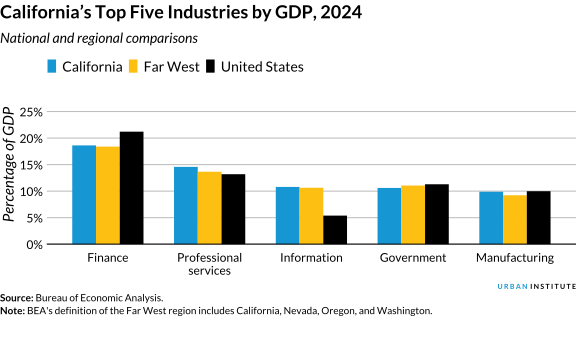
The major industries that contributed the most to California’s
gross
domestic product (GDP) in 2024 were finance, professional services,
information, government, and manufacturing. Professional services and
information contributed more to California’s GDP than they did to the
nation’s and region’s GDP, while government was less important to
California than it was to the nation and region in 2024.
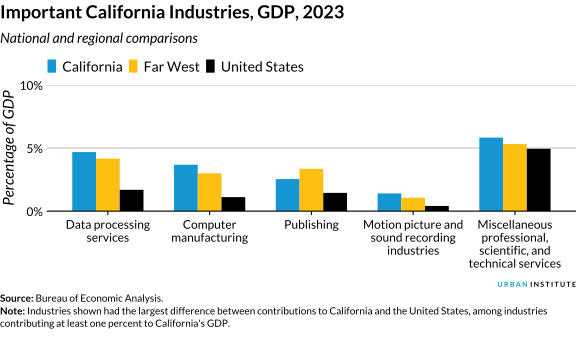
Looking at more specific industries, among those that accounted for
at least 1 percent of California’s GDP in 2023, data processing services
produced far more for the state than for the nation, contributing 4.7
percent to California’s GDP and 1.7 percent to the nation’s. Other
industries that overperformed in California relative to national
averages in 2023 were computer manufacturing; publishing; motion picture
and sound recording industries; and miscellaneous professional,
scientific, and technical services.
California’s politics
Governor Gavin Newsom, a Democrat, was elected in 2022 with
58
percent of the vote. The next gubernatorial election is in 2026.
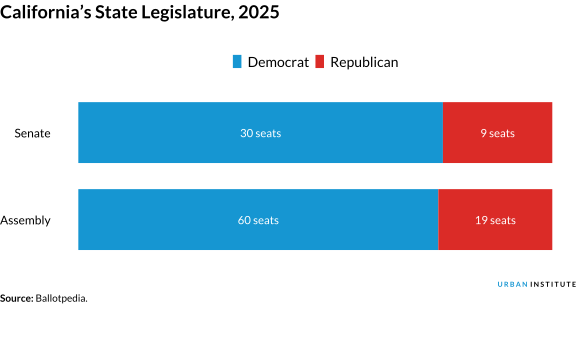
Democrats
control
both the Assembly (60 Democrats to 19 Republicans) and Senate (30
Democrats to 9 Republicans), with
veto-proof
majorities in both houses. Control of the governor’s mansion and
each house of the legislature gives Democrats a
trifecta
in California, which they have had since Newsom’s predecessor, Jerry
Brown, took office in 2011. All California Assembly seats are on the
ballot in 2026 because members serve two-year terms. Senators serve
four-year terms; roughly half the senatorial seats are on the ballot in
2026, and the other half will be up for election in 2028.
California’s demographics
As of July 2024, California’s population was 39,431,263. That was up
5.6 percent from 2010. The state’s population growth rate was slower
than than the nation’s 9.9 percent growth over the same period. The
Urban Institute
estimates
the state’s population will increase 15.7 percent between 2010 and 2030,
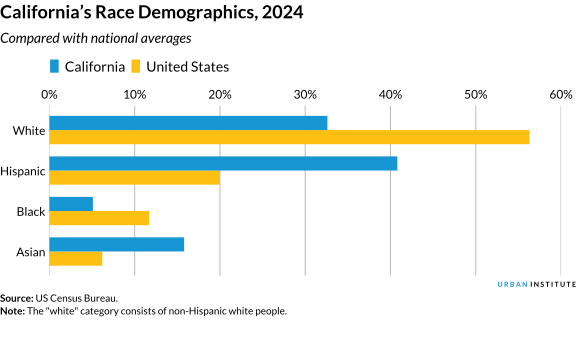
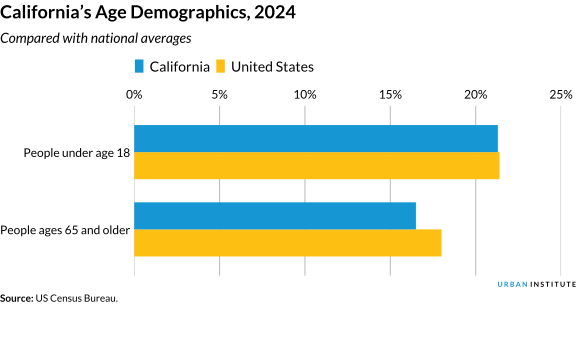
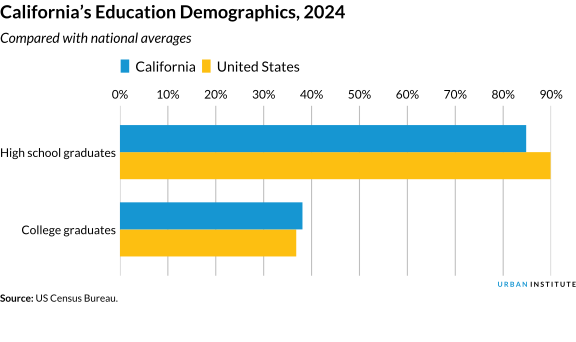
less than the nation’s estimated growth rate of 16 percent.