Massachusetts
As of July 7, 2022, Massachusetts had reported 9,699 COVID-19 cases per 100,000 people over the previous seven days, which ranks Massachusetts 42nd-highest in the nation. Since the start of the pandemic, Massachusetts has reported 1,932,346 total cases to the Centers for Disease Control and Prevention (CDC). That’s 28,036 cases per 100,000 people, which ranks Massachusetts 17th-highest in the nation for total cases.
As of July 7, 2022, Massachusetts had reported 15,449,704 vaccine doses administered to the CDC. That’s 224,152 doses per 100,000 people, which ranks Massachusetts third-highest in the nation.
At the start of the pandemic, Governor Charles D. Baker issued a stay-at-home order. It began on March 24, 2020 and lasted 55 days, making it the sixth-longest shutdown in the nation. Governor Baker strengthened and relaxed state restrictions according to the numbers of cases in the state. In December, the governor enacted additional capacity limits for businesses. These restrictions lasted until February 2021 when businesses were allowed to increase indoor capacity from 25 percent to 40 percent. The stay-at-home advisory and early closing requirements for businesses were also rescinded that month. In late April, the governor introduced a timeline for removing restrictions, with capacity increases permitted for large venues, amusement parks, bars, and breweries. All business restrictions and gathering limits were removed on May 29. The state is now fully “reopened.” This paragraph was last updated on October 1, 2021. For the more information, please see the New York Times.

Massachusetts’s private employment is down 99,900 jobs, or 3.1 percent, since January 2020. According to the latest Bureau of Labor Statistics data release, the other services industry experienced the greatest percentage decline in employment across the state, reporting 8.9 percent (12,400) fewer jobs since January. The largest total number of jobs lost was 32,400 (8.4 percent) in the leisure and hospitality sector.

The pandemic’s economic downturn had notably disparate effects on different workers, industries, and racial groups. For example, the accommodation and food services industry was hit particularly hard and unemployment rates were typically higher for Black and Latino Americans. Learn more about the variations in Massachusetts’s finances, economics, demographics, and politics on it’s state fiscal brief page.
Massachusetts’s Budget Actions
Governor Baker released his FY 2023 budget proposal and gave his state of the state address in January 2022.
Massachusetts enacted its FY 2022 budget in July 2021. The enacted budget included $47.6 billion in general fund spending, a 4 percent increase over FY 2021. (Massachusetts’s general fund includes spending that NASBO categorizes as “other state funds,” so the historical totals reported below are lower. See NASBO’s report for more detail.)
Under the American Rescue Plan, Massachusetts will receive $5.3 billion in direct state fiscal aid and $3 billion in local government aid from the federal government. As of January 2022, Massachusetts had spent part of its ARP funds on public health programs and revenue replacement.
According to NASBO, Massachusetts’s recent expenditure totals (general fund spending/total spending, including federal transfers) were:
FY 2021: $32.2 billion/$68.5 billion
FY 2020: $29.5 billion/$63.1 billion
FY 2019: $28.6 billion/$59.8 billion
Massachusetts’s total state tax revenue collections from the second quarter of calendar year 2020 to the first quarter of 2021 (combined) were 1.3 percent higher than over the previous (combined) four quarters. State tax revenue changes varied significantly across the states during this period, ranging from a 39.3 percent decline in Alaska to a 12.3 percent increase in Idaho. Overall, 18 states of 50 states reported lower revenue collections over that period in than the prior four quarters (download the state tax revenue data here).
Massachusetts has not yet reported data for fiscal year 2020. (Massachusetts’s fiscal year, like most state fiscal years, runs from July to June.) Most states experienced revenue declines in fiscal year 2020. A state’s tax revenue might be up, down, or steady depending on the prevalence of the novel coronavirus, the state’s major economic sectors, and its revenue structure, among other things. Additionally, while all states moved tax deadlines during the pandemic, different states reported this ‘shifted’ revenue in different quarters and fiscal years. This might also affect a state’s reported revenue growth.
Learn how to access and download state revenue collections data and revenue forecasting data for every state at the State and Local Finance Initiative’s data subscription page.
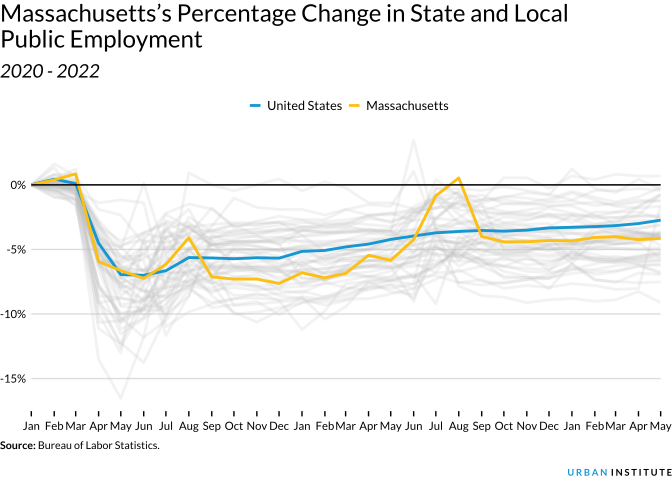
From January 2020 to May 2022, Massachusetts lost 17,900 state and local public jobs, a 4.3 percent decline.