|
|||||||||||||||||||||||||||||||||||||||||||||||||||||
|
|||||||||||||||||||||||||||||||||||||||||||||||||||||
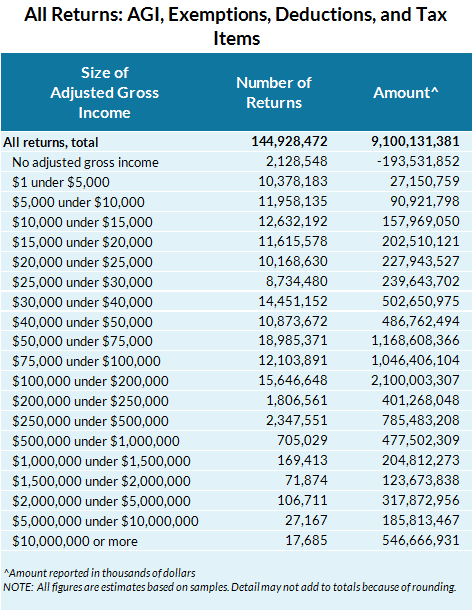
Line 37: Adjusted Gross IncomeDistribution | More Information
Source: IRS, Statistics of Income Division, Publication 1304, Table 1.4 (Data for Tax Year 2012). Line 1
Most medical and dental expenses are deductible but only to the extent that they exceed 10 percent of adjusted gross income (7.5 percent for people age 65 or over).Nearly 10.4 million taxpayers itemized $129 billion of medical expenses in 2011, when the threshold was 7.5 percent of AGI for all taxpayers.
Line 2
Total income subject to tax before exemptions and either the standard or itemized deductions (calculated on 1040 or 1040A).Line 3
Only medical expenses in excess of 10 percent of adjusted gross income (AGI) are deductible. That threshold is 7.5 percent of AGI for people age 65 or older.In 2011, the then 7.5 percent (of AGI) floor on medical deductions meant that itemizing taxpayers could not deduct a total of $44.3 billion of expenses, about one-third of all reported medical expenses.
Line 4
Taxpayers who itemize their deductions may deduct medical and dental expenses in excess of 10 percent of AGI (7.5 percent for people age 65 or over).In 2011, taxpayers deducted a total of $84.9 billion of medical expenses.
Line 5
Taxpayers who itemize deductions may deduct taxes paid to state and local governments. They may deduct income or sales taxes, but not both.In 2011, taxpayers deducted income and sales taxes totaling $282 billion.
Line 5a
Taxpayers may choose to deduct income taxes they pay to state and local governments. If they elect to do so, they may not deduct state and local sales taxes.In 2011, 33.7 million taxpayers deducted state, local, and foreign income taxes totaling $266 billion.
Line 5b
Taxpayers may choose to deduct sales taxes they pay to state and local governments. If they elect to do so, they may not deduct state and local income taxes.In 2011, 10.9 million taxpayers deducted state, local, and foreign sales taxes totaling $16 billion.
Line 6
Taxpayers may deduct real estate taxes paid to local, state, and foreign governments.In 2011, 40.1 million taxpayers deducted real estate taxes totaling $173 billion.
Line 7
Taxpayers may deduct taxes paid on personal property (such as cars, motorcycles, and recreational vehicles) but only to the extent that they are levied based on the value of the property.Taxpayers deducted $8.3 billion of personal property taxes paid in 2011.
Line 8
Taxpayers may deduct various other taxes, including income tax paid to foreign governments or US possessions.In 2011, 2.6 million taxpayers deducted other taxes totaling $1.9 billion.
Line 9
Taxpayers may deduct a broad range of taxes paid to local, state, and foreign governments.In 2011, 46 million taxpayers deducted tax payments totaling $465 billion.
Line 10
Taxpayers may deduct interest (and points) paid on a mortgage of up to $1 million ($500,000 for married couples filing separately) taken out to build, buy, or improve a main or second home, plus interest on a mortgage of up to $100,000 used for any other purpose.In 2011, 35.5 million taxpayers deducted a total of $358 billion of interest and points paid on mortgages and reported by lenders.
Line 11
Taxpayers may deduct interest (and points) paid on a mortgage of up to $1 million ($500,000 for married couples filing separately) taken out to build, buy, or improve a main or second home, plus interest on a mortgage of up to $100,000 used for any other purpose.In 2011, 1.1 million taxpayers deducted a total of $6.5 billion of interest paid on mortgages that were not reported by lenders.
Line 12
Taxpayers may generally deduct points paid on a mortgage in the year paid if the mortgage was used to build or improve the taxpayers main home. Other points must be deducted over the life of the loan.In 2011, 2.7 million taxpayers deducted a total of $1.4 billion of points paid on mortgages that were not reported by lenders.
Line 13
Taxpayers may deduct premiums paid in 2013 for qualified mortgage insurance, but only if the policy was issued after 2006.In 2011, 4.5 million taxpayers deducted a total of $5.4 billion of premiums paid for mortgage insurance.
Line 14
Taxpayers may deduct interest paid on loans used to acquire certain investment property.In 2011, 1.5 million taxpayers deducted a total of $12.6 billion of interest paid on loans used to purchase investment properties.
Line 15
Taxpayers may deduct interest paid on a variety of loans, subject to limits on the size of the loan and use of the loan proceeds.In 2011, 36.5 million taxpayers deducted a total of $384 billion of interest paid.
Line 16
Taxpayers may deduct contributions made in cash or by check to charitable organizations, but only to the extent that the donation exceeds any value the donor receives.In 2011, 34.6 million taxpayers deducted a total of $139 billion of gifts to charitable organizations made by cash or check.
Line 17
Taxpayers may deduct contributions of property to charitable organizations, but only to the extent that the donation exceeds any value the donor receives.In 2011, 22.5 million taxpayers deducted a total of $44 billion of in-kind gifts to charitable organizations.
Line 18
Charitable contributions are limited to no more than 50 percent of AGI. Donations over the limit may be deducted in future years.In 2011, 579,000 taxpayers claimed a total of $33 billion of charitable contributions carried over from previous years.
Line 19
Taxpayers may deduct contributions made in cash or in kind to charitable organizations, net of any value received by the taxpayer and subject to limits based on income.In 2011, 37.8 million taxpayers deducted a total of $174 billion of gifts to charitable organizations.
Line 20
Taxpayers may deduct losses due to theft, fire, storm, accidents, or other causes, subject to limits and only in excess of 10 percent of adjusted gross income.In 2011, 141 thousand taxpayers deducted a total of $3.2 billion of casualty and theft losses.
Line 21
Taxpayers may deduct job expenses that are not reimbursed, subject to an overall limit on these and other miscellaneous deductions.In 2011, 14.7 million taxpayers claimed a total of $77 billion of unreimbursed employee expenses.
Line 22
Taxpayers may deduct costs of tax preparation services or tax software.In 2011, 22.1 million taxpayers claimed a total of $7 billion spent on tax preparation fees.
Line 23
Taxpayers may deduct a variety of expenses related to earning income or protecting property.In 2011, 7.9 million taxpayers claimed a total of $38 billion in miscellaneous expenses related to earning income or protecting property.
Line 24
Total deductible job and miscellaneous expenses, before subtracting 2 percent of income floor on such deductions.In 2011, 28.7 million taxpayers claimed a total of $122 billion of job and miscellaneous expenses.
Line 25
Total income subject to tax before exemptions and either the standard or itemized deductions (calculated on 1040 or 1040A).Line 26
Taxpayers may deduct job and miscellaneous expenses that exceed 2 percent of incomeIn 2011, the floor on deducting job and miscellaneous expenses averaged about $2,600 for the 28.7 million taxpayers reporting those expenses. Line 27
Taxpayers may deduct job and miscellaneous expenses that exceed 2 percent of incomeIn 2011, 11.9 million taxpayers deducted a total of $86 billion of job and miscellaneous expenses that were in excess of 2 percent of their adjusted gross income.
Line 28
Taxpayers may deduct other miscellaneous expenses, such as gambling losses and casualty and theft losses on income-producing property.In 2011, 1.3 million taxpayers claimed a total of $18 billion of gambling losses, $1 billion of property income, casualty, and theft deductions, and $2 billion of other miscellaneous deductions.
Line 29
Itemized deductions are reduced for high-income taxpayers.The limitation on itemized deductions for high-income taxpayers was repealed for the 2010-2012 tax years, but was reinstated in 2013.
Line 29
Taxpayers with income under specified limits may claim the full value of their itemized deductions.Itemized deductions are not limited for single tax filers with an AGI under $250,000, heads of household with an AGI under $275,000, and married couples who file jointly and have an AGI under $300,000. Line 29
Itemized deductions are reduced for high-income taxpayers.Itemized deductions are reduced by 3 percent of AGI in excess of thresholds: $250,000 for single filers, $275,000 for heads of household, and $300,000 for married couples who file jointly. Deductions cannot be reduced by more than 80 percent. Line 30
Taxpayers may itemized their deductions or claim the standard deduction. Itemizing can sometimes reduce taxes, even if the standard deduction is larger.In 2011, 125,000 taxpayers chose to itemize deductions, even though their standard deductions were larger. |
|||||||||||||||||||||||||||||||||||||||||||||||||||||
© Urban Institute, Brookings Institution, and individual authors, 2013. Site Map | Privacy Policy | Support TPC | Contact Us |
|||||||||||||||||||||||||||||||||||||||||||||||||||||